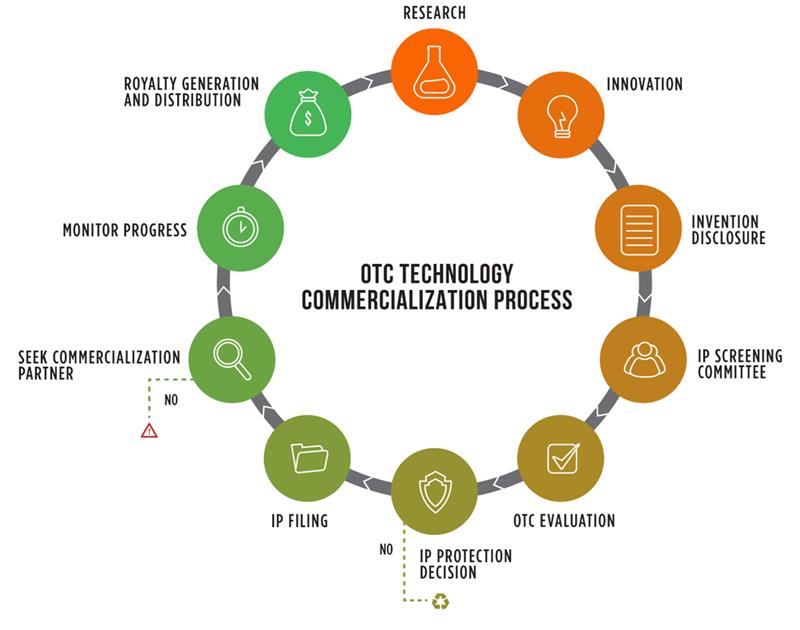
OSU Technology Commercialization Process
-
Research Enterprise
Research is one of three essential components of Oklahoma State University’s land-grant mission. OSU’s research expenditures exceed $250 million annually (FY 2024). This research enterprise encompasses, but is not limited to the following areas:
Unmanned Aircraft Systems (UAS)
Energy Technologies
Food Safety & Security
Independent Living
STEM Education
Toxicology
Health Care
Water Stewardship
Respiratory & Infectious Diseases
Biobased Chemicals
Educational Research & Evaluation
-
Invention
Invention is an act of creating a new device, method, process or composition developed from study and experimentation that never existed before.
Most inventions can be protected by law, including Utility Patents, Plant Patents, Design Patents, Copyrights, Trade Secrets or Trademark, or by a combination of these options, which are further discussed under IP Evaluation and IP Filing.
According to U.S Patent Law a patentable invention is: Any new, useful, and non-obvious process, machine, article of manufacture, or composition of matter that falls within the guidelines of patent-eligible subject matter. For further details on what constitutes a patentable invention, please see IP Evaluation.
-
Invention Disclosure
Disclose Your Innovation
Disclosure Explained
When a researcher/faculty of OSU has derived an invention from their academic work, they should submit an invention disclosure detailing their invention to the Office of Technology Commercialization (OTC). One can download the appropriate Disclosure Form (referred in our website as Invention Record & Report Form), answer all questions, and submit it to the OTC.
The term “disclosure” as it is used in intellectual property has three meanings: One is when an inventor notifies an associated or affiliated agency (in OSU’s case, the OTC) that he/she has an invention and describes the invention in detail. Another type is a ”public” disclosure. This is when an inventor makes the invention known to the general public, in a tangible form. A public disclosure of the invention before filing for a patent may bar one from obtaining a patent. The third is a confidential disclosure, when an inventor makes an invention known to a third party agency, but under an agreement of confidentiality.
It is important to understand that a disclosure to the OTC does not immediately protect the invention. For example, OTC has to file a patent application for the invention to be protected through the patent process.
Inventorship & Authorship
Who is an inventor?
An inventor is a person who conceives** the subject matter of at least one claim of the patent and/or inventively reduces the invention^^ to practice.
**“Conception is complete only when the idea is so clearly defined in the inventor’s mind that only ordinary skill would be necessary to reduce the invention to practice, without extensive research or experimentation” (Burroughs Wellcome Co. v Barr Labs, Inc.).
^^Inventive Reduction to Practice requires further innovation of initial inventive idea (somethingunexpectedbeyond that of ordinary skill).
For more details visit: Who is an inventor page.
Copyright and Authorship
Copyright and authorship are similar to inventorship in that they deal with concepts and ideas. Copyright protection exists from themoment of fixationof a work for all original works or authorship fixed in ANY tangible medium. Copyright does not protect an abstract idea but rather only a specific, concrete expression of an idea. Example: LOVE is an abstract idea. It cannot be copyrighted, but any concrete expression of love (songs, odes, books, paintings, etc.) that are concrete expressions of love, can be and regularly are, copyrighted. FIXATION: Recorded, transcribed, or stored for more than a fleeting duration. A work is FIXED when its embodiment is “sufficiently permanent or stable to permit it to be perceived, reproduced, or otherwise communicated for a period of more than a transitory duration” (17 U.S.C. Section 101)
IP Policy
Handling of the Intellectual Property generated at Oklahoma State University is governed by the following university policy and procedure:
- OSU Policy and Procedures No. 1-0202- Intellectual Property
-
University Intellectual Property Screening Committee
The University Intellectual Property Screening Committee (UIPSC), appointed by the President and composed of members for the terms as set forth in theOSU Policy and Procedures No. 1-0202, act as an authority of first resort to decide whether the University has a proprietary interest in disclosed intellectual property. All disclosures that the OTC receives are referred to UIPSC for a determination of proprietary interests therein under the provisions of OSU’s IP Policy.
If UIPSC, with the concurrence of the Vice President for Research, determines that the university has a proprietary interest in the intellectual property under sections 3.02 or 3.03 of OSU Policy and Procedures No. 1-0202, the Committee notifies the inventor(s)/creator(s). In determining rights under this provision, the fact that the subject matter of the intellectual property is related to the individual's employment, appointment or association with the university and/or the use of university resources, facilities, equipment, materials, supplies, or services in creating or developing the intellectual property shall constitute prima facie evidence of the university's proprietary interest therein.
If UIPSC, with the concurrence of the Vice President for Research, determines that the university has no proprietary interest in the disclosed intellectual property under section 3.1 of OSU Policy and Procedures No. 1-0202, the inventor(s)/creator(s) shall so be notified and any further action pertaining to the invention shall be the sole responsibility of the inventor(s)/creator(s). -
OTC Evaluation
After it has been determined that OSU has proprietary interest in a disclosure submitted to the OTC, a thorough evaluation of the disclosure is carried out to determine the commercial viability of the invention. The OTC evaluation process has two main components:
Intellectual Property evaluation to determine the ability to protect the intellectual property (IP) of the invention
Market evaluation to assess the commercialization opportunity for the invention
IP Basics
What is an Intellectual Property?Intellectual Property (IP) describes a wide variety of property created by inventors, musicians, authors, and artists. To be more precise, IP is a work or invention that is the result of creativity (a work of the mind), and can be in the form of an invention, manuscript, or a design to which one has rights and may apply for a patent, copyright, and/or trademark. An additional type of IP is a Trade Secret, which can be in the form of know-how or data. Last, an inventor may decide to publish their intellectual property to make it freely available to those interested.
Types of Intellectual Property
Patent- According to U.S Patent Law a patentable invention is: Any new, useful, and non-obvious process, machine, article of manufacture, or composition of matter that falls within the guidelines of patent-eligible subject matter. Of course, the many types of patents available complicate this. For more information, see Types of Patents below.
Copyright-Protect creative works, such as books, movies, software and photographs, giving the author protection from others trying to use copies of the copyrighted material. The duration is 70 years from first publication for works made for hire.
Trade Secrets-Information that is subject to reasonable efforts to be maintained as secret that derives independent economic value from not being generally known to or readily ascertainable by others. A Trade Secret does not expire.
Trademark-A trademark is a mark that indicates that a specific entity is responsible for the product or service. No other entity can use the mark, and if they did, legal consequences would apply. Federally registered trademarks last for 10 years but can be renewed indefinitely in 10-year increments.
1. IP Evaluation
Patent Eligible Inventions
The majority of technology developed out of the university requires that a patent be obtained in order to commercialize the invention. Because we usually work with patent protection, we will explain this evaluation process in detail below. However, we also work with other types of IP, such as trademarks and trade secrets. If your invention is best suited for these forms of protection, we will guide you through these processes as well.
Despite what you may have heard, you cannot obtain a patent on anything…..but you can onalmostanything that is new. A quote often cited in patent law is that “anything under the sun that is made by man” can be patented ("include anything under the sun that is made by man." S Rep. No 1979, 82d Cong., 2d Sess., 5 (1952); H.R.Rep. No. 1979, 82d Cong., 2d Sess., 6 (1952). In other words, if you merely make a discovery, it does not mean that you are entitled to a patent. It was a fact all along, and you were merely the first to observe it. But if your invention uses “the hand of man,” you may be entitled to a patent.Processes, machines, compositions of matter, articles of manufacture, software and methods that embody four qualities can be patented.
What are those qualities? Statutory subject matter, utility, novelty, and non-obviousness.
Statutory subject matter– The first requirement is the claimed invention must be eligible subject matter. Because almost everything is patent eligible, it is easier to state what is not patentable: (a) laws of nature, (b) physical phenomena and (c) abstract ideas.
Laws of nature– Laws based on observations and experiments that govern how nature works. For example, Sir Isaac Newton could not have patented the law of gravity.
Physical phenomena– Similar to laws of nature, physical phenomena are naturally occurring events involving physical properties of matter and energy. For example, lightning is something you cannot patent.
Abstract ideas– This is a bit trickier than the rest. The definition of an abstract idea is that concepts that need to be visualized, as they cannot be illustrated through concrete examples. The Supreme Court has stated, “[a] principle, in the abstract, is a fundamental truth; an original cause; a motive; these cannot be patented” (Le Roy v. Tatham,55 U.S. (14 How.) 156, 175 (1852). A great example of an abstract idea often used is mathematical algorithms.
Utility –An invention must provide some identifiable benefit and be operative. A commonly used example of an invention that has no utility is a perpetual motion machine. You cannot patent an invention that produces more energy than it consumes because of the belief that an invention cannot have utility if it does not work.
If your invention passes the utility and statutory subject matter requirement, good news! You have passed two of the four hurdles to obtain a patent. The next two are the most difficult to clear:
Novelty– An invention must be new. In other words, the invention must not be known to the public already. The purpose of this rule is to ensure that inventions that are already known to the public cannot be patented.
Non-Obviousness– An invention must not be obvious. This is often determined by the following process: 1) Determine the scope and content of what is already known 2) Determine differences between the claimed invention and prior art and 3) Resolve the level or ordinary skill in the art at the time of the invention. It must then be determined whether “the differences between the subject matter sought to be patented and the prior art are such that the subject matter as a whole would have been obvious at the time the invention was made to a person having ordinary skill in the art …” (Manual of Patent Examining Procedure). In addition, there are “secondary considerations” that can be used to show non-obviousness, such as the invention’s commercial success, or failure of others to reduce the invention to practice.
How do you show your invention is novel and non-obvious? By finding the knowledge already known to the public prior to the priority date of the invention (the day you file a patent application), and comparing that knowledge to your invention. If your invention provides a novel and non-obvious inventive step, then you may be entitled to a patent.
Prior Art
Prior art is the term used for existing information that will demonstrate an invention is not novel and/or non-obvious.This includes printed publications, public use, sale offers or inventions otherwise made available to the public.If prior art is found from other groups, it can lead to a bar for the ability to patent an invention if that prior art demonstrates the invention is not novel and/or non-obvious.
Public Disclosures
A public disclosureis when an inventor makes his invention known outside the university, which can also lead to a bar for obtaining a patent. The most common type of public disclosure we deal with at a university is “printed publications.” This is misleading however, because any disclosure can be used against a patent application if it teaches someone with ordinary skill in the art to practice the invention without undue experimentation. This is true whether it is a publication or poster presentation. Even a grant that is only available through the FOIA may be considered a public disclosure.
Another form of public disclosure occurs when the inventor performs a public use of the invention or offers it to another party in a public sale, whether it enables someone to practice the invention or not. A new inventor-friendly rule is that the public must be aware of the use of the invention. For example, if the invention was used on public land in the middle of the desert that only the inventor knew about, that is not considered a public use. Overall, what constitutes a public disclosure causes some of the most confusion in patent law.
This is why it is absolutely critical to inform the OTC of your invention before any potential public disclosure is made. Please contact the OTC to help preserve your patent rights if you believe a public disclosure of your invention will occur. Luckily, even if you already made a public disclosure all is not lost.
In the US, inventors have aone-year grace periodfor public disclosures that originate from their work. However, most other countries do not have a grace period. This means that any public disclosure may bar the ability for us to patent the invention in other countries.
2. Market Evaluation
Market evaluation consists of identifying where the invention fits into an industrial system. Is there a cadre of companies that might use the invention? The OTC uses many different resources to make this evaluation. SIC (Standard Industrial Classification codes are four-digit numerical codes assigned by the U.S. government to business establishments to identify the primary business of the establishment.) and NAICS (North American Industry Classification System is used by businesses and governments to classify and measure economic activity in the United States, Canada, and Mexico. NAICS is 6-digit code system that is currently the standard used by federal statistical agencies in classifying business establishments.) codes are a good place to start. Often, however, the PI is the best source to start looking for commercial partners.
The Total Available Market is then determined. This is the whole size of the market, with all the players (companies) in it. Then the OTC determines the Potential Available Market, or how much of that market the new invention can expect to serve. This is an inexact science. It mostly depends on the structure of the industry and how likely the technology can attract either a major player in the industry (think Google) or an up-and-comer who is willing to attack the major player and might need a technological innovation for an advantage (think Tesla). It also depends on how disruptive the technology is. A very disruptive technology might be able to capture a greater share of the market. However, a very disruptive technology carries a lot more risk, because persuading customers to switch away from current technology can be very difficult.
Commercialization Potential
This depends on several things. First, how developed is the invention? The OTC uses Technology Readiness Levels for relevant inventions [https://en.wikipedia.org/wiki/Technology_readiness_level] (TRL). If the TRL is 3 or less, then it still needs more development to begin to determine its commercial potential. At TRL 7 and above, it becomes easier to both attract a commercial partner, and to demonstrate the features and benefits of the invention.
However, if the invention is promising, and can potentially provide a competitive advantage to a company, then it may be possible to get sponsored research funding to get from TRL 3 to 7 (or higher).
Active Marketing
Once suitable industry and market(s) are identified, OTC does several things. First, the OTC provides a non-confidential abstract of the invention using key words that are common in the given industry which is published on a commercial website [http://okstate.flintbox.com/ and www.ibridgenetwork.org]. Also, licensing associates at the OTC may make contacts at companies that might be interested in the technology. This is where the PI’s experience comes in: the PIs are more likely to know the players in a given industry or company. Licensing associates might also attend one or more conferences (scientific, industrial or trade) at which a collection of companies in an industry might be in attendance. The OTC might also (although rarely) send large scale blast notices via email to potential companies in an industry. The OTC is also beginning to use social media to get word out (Facebook, Twitter).
-
IP Protection Decision
After considering the invention disclosure for a.) novelty; b.) protectability; c.) marketability; d.) time to market; e.) money required for further development; f.) growth and size of market; g.) existing IP that may preclude the ability to practice the invention; and h.) current competition, the OTC will make a determination if pursuing IP protection is in the best interest of OSU. If we do determine that we cannot pursue IP protection at this time, an OTC employee will work with the PI to determine potential trajectories for the invention.
-
IP Filing
Intellectual property of an invention can be protected in multiple ways. The appropriate method of IP protection is often dictated by the nature of the invention and, in some cases, the commercialization strategy. The OTC will work with the inventor to determine the most appropriate path. Since most of the work submitted to the OTC involves patentable inventions, we will describe the patent process in detail below.
Types of Patents
AProvisional Patent Applicationis a place holder that sets the ‘priority date’ for the invention. This allows a person to set a filing date for an invention, without submitting the full Utility Patent application. A provisional patent application is not reviewed by the USPTO. It sits on the shelf for 1 year then expires. A Patent Cooperation Treaty (PCT) application or utility patent must be filed within that year to claim the benefit of filing a provisional application.
PCT application- The PCT is an international patent law treaty, concluded in 1970. It provides a unified procedure for filing patent applications to protect inventions in each of its contracting states. A patent application filed under the PCT is called an international application, or PCT application. There is no such thing as an international patent. Instead, one must submit in each country a patent is desired during a nationalization stage.
Utility Patents- Provide a time-limited 20 year monopoly for processes, machines, compositions of matter, articles of manufacture, software and methods that are novel, useful, non-obvious and within statutory subject matter (i.e., you cannot patent laws of nature, such as gravity).
The utility patent process is most often used by the OTC, which includes provisional, utility and PCT applications, and utility patents. It takes a number of years to complete and is an expensive process. It also requires the inventor and the OTC to work together and meet on multiple occasions in order to successfully navigate the patent process. The end result is hopefully a patent with broad protection that can be commercialized successfully.
Design Patents- Design patents are granted to any person who has invented a new, original and ornamental (nonfunctional) design for an article of manufacture. In essence a design patent covers the look and feel of the invention, not the functional aspects of an invention. For example, the iPhone design, fonts and even the statue of liberty have been awarded design patents. A design patent has a term of 14 years.
Plant Patents- Plant Patents cover asexually reproduced distinct, new varieties of plants, including cultivated spores, seeds, mutants, hybrids, and newly found seedlings, other than a tuber-propagated plant or a plant found in an uncultivated state. A plant patent has a term of 20 years.
Plant Variety Protection Certificate- Protection for a person who generates a new sexually propagated plant. This type of patent is managed by the US Department of Agriculture, instead of the USPTO. The protection lasts for 20 years date (25 years for vines and trees).
Patent Process Outline
The graphic below should give you a general idea of the patent process. Inventors at OSU should familiarize themselves with this graphic, and use it as a guide for the patent prosecution process, and how long it may take. In the first section we will describe how you can work with the OTC for optimal patent prosecution. Next, we will discuss the patent timeline in detail, including the two routes (US and PCT applications) that the OTC often employs to protect OSU inventions.
Patent Prosecution Process and How it Relates to the Inventor
The member of the OTC assigned to a particular disclosure will assess the invention to find out if a patent application is appropriate. If the decision is made to file, the OTC will work with the PI and an outside attorney to draft the patent application. The completed patent application will be submitted to the USPTO, likely first as a provisional patent application. This is followed by filing a Utility (non-provisional) US patent application seeking protection in the US and/or a PCT application, which begins the process of seeking protection in the US and other countries (see below for details). Filing a utility or PCT patent application will trigger the patent prosecution process.
The patent process is a negotiation with the patent examiner. The attorney, the OTC, and the inventor must work together in order to respond to the examiner, who will often initially reject an application based on patent formalities and/or prior art. When the application is rejected, the patent attorney must file a written response within 3-6 months. Generally, this will result in the attorney either amending the claims and/or arguing why the patent examiner is mistaken in their assessment.
The end goal is to secure as broad of a patent as possible from the patent examiner.This requires an inventor who will stay engaged throughout the ~ 3.5 year process, and will provide input to confirm the patent attorney’s understanding of the technical aspects of the invention and/or the prior art cited by the examiner.
The OTC typically files provisional patent applications on 50% of the disclosures received, and files a PCT and/or US application on 40-50% of the provisional patent applications filed.
Detailed Look at the Patent Process
Filing a Provisional Patent Application
A provisional patent application is a place holder that sets the ‘priority date’ for the invention. A provisional patent application is not reviewed by the USPTO, and there is no such thing as a provisional patent. It sits on the shelf for 1 year.
If a Utility (non-provisional) U.S. patent application or PCT application is not filed before the one year is over, then the ‘priority date’ is lost. The priority date claims the date of the invention. This is critical because: 1) the person with the earliest priority date for a specific invention will be the one to receive a patent under the U.S. first-to-file system and 2) if information from a third party is disclosed to the public before the priority date, it may be counted as prior art that can bar the inventor from obtaining a patent. This is also true if the inventor publishes his/her own work, although a few countries grant a grace period to the inventor, (one year in the U.S.). See more information about what constitutes a public disclosure and what the grace period means in the IP Basics section.
At a university, publishing and presenting are important— but they are also public disclosures. Due to the effect a public disclosure may have on patentability, a priority date will protect the invention from a pending public disclosure. If an inventor or a student needs to publish a paper that includes critical information in an invention, the OTC can file a provisional application to ensure that the subsequent disclosure comes after the priority date. Generally, the cost of filing a provisional patent application is not substantial (less than $5,000).
Filing a Utility (Non-provisional) U.S. Patent Application
A Utility (non-provisional) application is a formal U.S. patent application (U.S. route), which will trigger the official examination process with the USPTO to determine if the invention is patentable. In addition, 18 months after the original priority date, the application will be published.
The USPTO will assess if the patent application should be granted or rejected and inform the university of its opinion through office actions. The first office action will usually occur 6-18 months after the filing date of the Utility (non-provisional). Almost always without fail, the patent application will be rejected based on patent formalities and/or prior art. The patent attorney, along with the inventor and the OTC will come up with arguments as to why the patent examiner is mistaken and/or amend the application to satisfy the patent examiner.
The best way to view the patent prosecution process is that it is a negotiation between the inventor and the patent office to determine if, and how broadly the invention can be claimed. Multiple office actions rejecting an application often occur during this process before a patent is granted or finally rejected (~50% of patent applications filed become patents). Typically, the time it takes for a patent to be granted is 3-5 years after filing the original provisional patent application, the cost is around $20,000, and the patent term will be 20 years from the original priority date established by the provisional application, provided the maintenance fees are paid. Because of the cost, before filing a Utility (non-provisional) the OTC will ideally have found a licensee who will pay for the prosecution. However, even without a licensee the OTC will file a Utility (non-provisional) if there is market interest in the application and/or the application has a strong market opportunity report that justifies the expense the OTC will take on due to prosecution.
PCT Application
The Patent Cooperation Treaty (PCT) is an international patent law treaty that provides a unified procedure for filing patent applications to protect members in the contracting states, of which there are currently 148. A PCT application is used when there is a need to obtain patent protection outside the U.S. The PCT route can be taken either concurrently with the U.S. route, or a PCT can be the sole route to obtain patent protection within and outside of the U.S.
A PCT application can be filed with various patent offices, and the OTC usually choose either the European Patent Office (EPO) or the USPTO. Four months after filing, the patent office we chose will provide a preliminary and non-binding International Search Report (ISR) that will find the most relevant prior art, and a Written Opinion (WO) assessing if the invention is patentable. This can help an applicant gauge the potential for patenting their invention before entering the notoriously expensive national phase.
There is no such thing as an “international patent” and in order to obtain a patent in individual countries, the PCT application must enter the national phase, which the applicant must begin 30 months (some jurisdictions allow later than 30 months) from the earliest priority date of the patent application. Prosecution will then be done at the national level (or regional in the case of European Patent Office), and all patent applications will be evaluated according to the rules and regulations of that jurisdiction. Although usually similar to the USPTO, every country has variations to the prosecution process and rules for patentability. The cost to file in many individual countries is often cost prohibitive for OSU (over ~$100,000), and in almost every case a licensee must have already licensed the technology in order to shoulder the cost of the national phase. Patent lengths and terms will also vary according to the jurisdiction, but many are similar to the U.S. award of 20 years from the initial priority date.
-
Seek Commercialization Partner & Licensing
Licensing Terms
Option
A License Option Agreement is a contract between the university and a company that grants the company an option to acquire commercialization rights to an invention in the near future. Normally, an option is granted for a company that has an interest in the technology but does not know yet how well it can be commercialized. Sometimes an option is granted as part of a Sponsored Research Project, so that the investing company knows it has rights to the developed technology. An option holds the technology for the company for a defined period to allow the company to do research (both technical and market) to determine if the invention has value.
License
A License Agreement is a contract between the university and a company for rights to commercialize an invention. A license for an invention can be for an issued patent, a pending patent, a Trademark or knowhow. It can also include copyrighted material. A license simply provides the licensee the right to practice the technology or invention. A license can be world-wide in scope or limited to a geographical area. It can be exclusive or non-exclusive. It can be for a specified field of use. The field of use can be a technology area, a market area, or a geographical area.
The licenses OSU executes have several components. They specifically list the technology licensed, by using the OSU Disclosure Number and Title. If a patent or patents are pending or issued, that too is listed. The licensee is designated. The level of exclusivity and fields of use are given. An up-front fee is usually included, which will probably be applied to the patent prosecution costs that have been accumulated. A royalty rate is given and often a minimum royalty that is non-refundable, to ensure the licensee actually commercializes the invention(s). Performance milestones may be indicated. A schedule of payments to cover past and continuing IP/Patenting costs may be included. Termination by either party is spelled out, when, under what circumstances, and what notices need to be given before termination (usually with some sort of period to fix the problem).
Licensing to a Startup
The OTC encourages students and faculty members starting a company with OSU – to license intellectual property. Licensing to a startup is somewhat different than licensing to an existing company.
Option: We often start with an option agreement to a startup
Option Terms:
Smaller upfront fee
Specific performance terms to meet before converting the option to a license
Most option performance terms deal specifically with the development of the technology, but for startups, we also want to see progress towards a viable business plan, business model, product, and funding.
If the performance terms are not met, the option will expire. IF they are met, then a license can be negotiated.
License: Similarly, license terms for a startup are somewhat different than for an existing company.
Licensing Terms:
Smaller up-front fee again, but with a larger payment down the road, after certain performance milestones are met.
Performance milestones related to funding, product development and first sales. Royalties might be deferred until sales hit a certain level. If performance milestones aren’t met, then the license can be terminated.
Ecosystem to support commercialization through Startups
Cowboy Technologies
Cowboy Technologies, LLC is a for-profit entity established to provide early seed-stage activities for OSU developed technologies. Technologies are carefully screened from the OTC's portfolio and reviewed before being selected as a CT 'Project'. Technologies that demonstrate the greatest potential for entity launch and long-term success receive highest consideration. Project support to launch includes:
Assisting in later stage investment strategies and finding early seed stage funding
Identifying and securing long-term management capabilities
Facilitating participation in the SBIR/STTR program
Providing seed funding up to $200,000 depending on milestone attainment
School of Entrepreneurship and Riata Center
The School of Entrepreneurship and Riata Center operate within a broader ecosystem that provides support to business startup and technology commercialization efforts on campus.
i2E
i2E is a private, non-profit corporation focused on funding and growing innovative small businesses in Oklahoma.
What happens if we do not find a partner?
Finding a partner to help commercialize university inventions is often a difficult process. There are many great technologies coming out of OSU, but because of market realities companies may not be able or willing to take a license to commercialize an invention. In these cases, the OTC will work with the inventor to identify the best possible route for the technology. One route is to develop the technology further by identifying industry partners that are willing to provide sponsored research to the lab, obtaining additional outside grants and/or Gap funding and attempt to license the technology when it is further developed. Another is the inventor(s) and the OTC make a joint determination that the technology would better serve the public by publishing a paper and cease commercialization efforts.
-
Monitoring Progress
After a technology is licensed to a company, the OTC actively monitors its progress of commercialization. The OTC will work with the licensee on continued patent prosecution and/or obtaining new patents. The OTC also requires an annual progress report and commercialization plan to be submitted by the licensee. This is to ensure visibility into the commercialization efforts of the licensee and allows for discussion of ways in which OSU may be of assistance. These reports normally stop upon the commencement of products sales.
-
Royalty Generation & Distribution
Royalty Distribution Policy
The royalty paid to OSU is usually a percentage of gross or net sales of products or services resulting from the licensed patents and/or trade secrets. The royalty percentage is based on a number of factors that include the type of patent, the markets in which the products will be sold, and the margins expected from product sales.Royalty income generated from licenses or other marketing arrangements concerning University Intellectual Property is distributed according to the following guidelines as per the university IP policy OSU Policy and Procedures No. 1-0202 (Distribution of Income):
All direct costs incurred by the university in obtaining, maintaining, and protecting the patent or other protection for the property, licensing, and/or marketing of the property shall first be recaptured from any royalties received by the university.
After recovery of the above costs, the remainder of the royalty income shall be distributed as follows:
50% to the creators(s),
30% to the Innovation Foundation at Oklahoma State University / Office of Technology Commercialization, and
20% to the college(s)/division(s) with which the creator(s) are afflicated.